
Of all the occasions for offering in Theravāda Buddhism, there is one that monastics and laypeople alike look forward to all year, yet it can be held only once and within a very short period. That is the Kaṭhina — the robe-offering ceremony. It is special not because of lavish offerings, but because of a strict set of conditions, a moving origin story, and a rare spirit: cooperation between the lay community and the Saṅgha raised to an art.
What Kaṭhina is — the big picture first
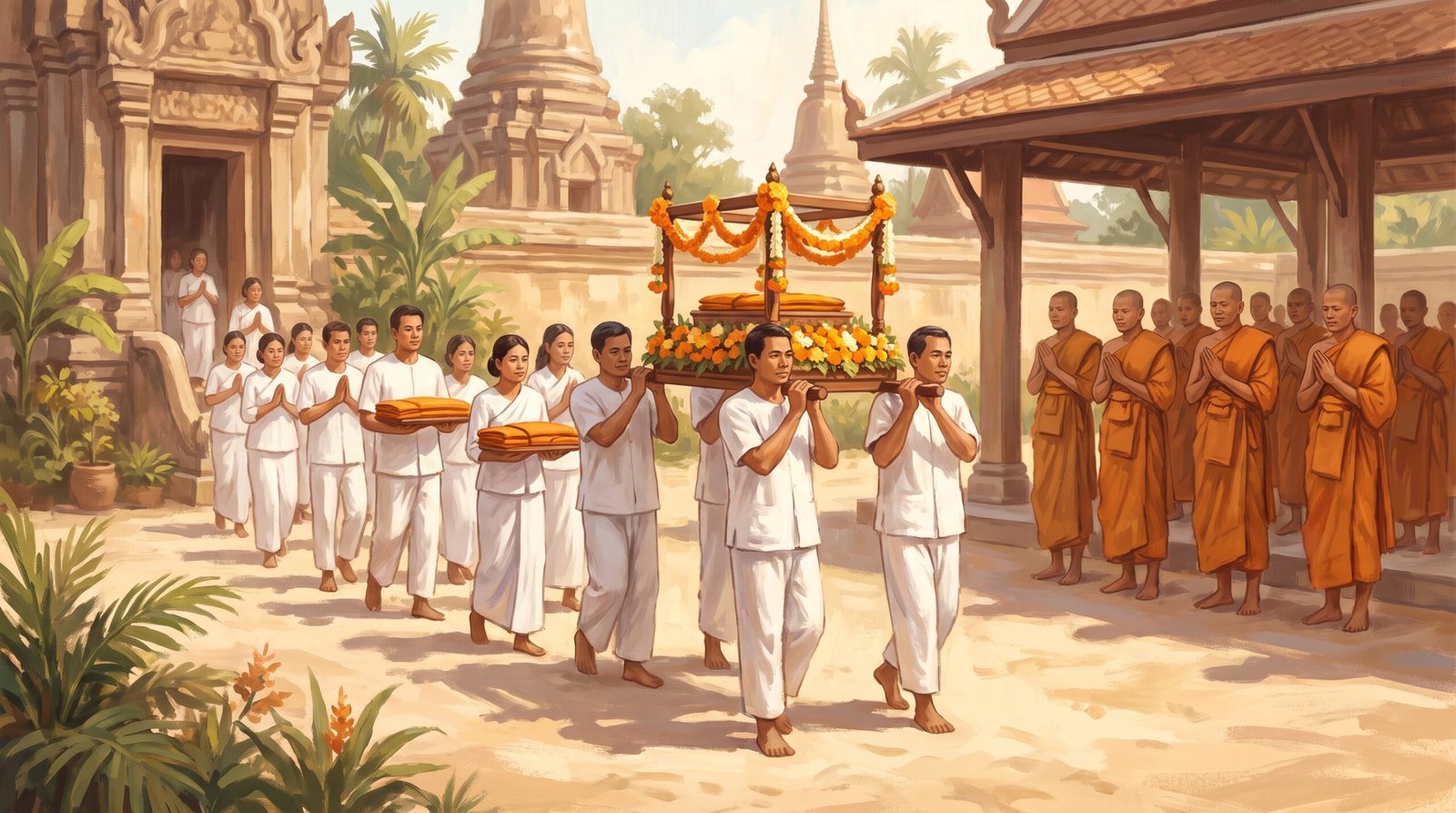
The word kaṭhina originally means “the frame for stretching cloth” — the tool monks used in ancient times to sew their robes. Over time the name of that tool became the name of the whole ceremony: the offering of a robe sewn on the frame. In short, Kaṭhina is a ceremony in which laypeople offer robe cloth to a Saṅgha that has just completed the rains retreat, and the Saṅgha together receives it, makes the robe, and designates a worthy bhikkhu to use that robe.
What sets Kaṭhina apart from every ordinary occasion of offering is that it cannot take place at just any time. There is a defined “time window”, a condition on the number of bhikkhus, and a clear sequence of formal Saṅgha procedure. It is this strictness that turns a simple gift of cloth into a ceremony of great spiritual weight. To see where Kaṭhina sits within the whole of monastic discipline, you can visit the Vinaya Piṭaka — Vinayapiṭaka section.
The origin story: thirty bhikkhus and a robe
Like every rule in the Vinaya Piṭaka, Kaṭhina arose from a concrete situation. The story goes that thirty bhikkhus were travelling together to see the Buddha, but the rainy season arrived and they had to stop and spend the rains retreat on the way. After three months they hurried on in robes soaked with water, tired and muddy. Seeing this, the Buddha out of compassion allowed the Saṅgha, after the rains retreat, to receive the Kaṭhina robe — both so they would have new robes and so they could enjoy certain relaxations that made keeping their robes less burdensome.
Kaṭhina was not born from a cold rule, but from the image of monks caked in mud after three months of rain. Behind a set of conditions that seems dry stands a Buddha who observed very keenly and cared very truly.
Why only one month a year
This is the defining feature that makes Kaṭhina so precious. The ceremony can be held during one single month only, from the day the rains retreat ends (Pavāraṇā, after the invitation ceremony) until the full moon of the following month. Outside this period, however much one may wish to, a Kaṭhina robe cannot be offered in accordance with the Dhamma.
This time limit is not meant to make things difficult, but to preserve the original meaning: Kaṭhina recognises and supports those who have truly completed the rains retreat in full. You can learn more about those three months of the rainy season in the article on the regulations governing the Saṅgha (Khandhaka), which describes both the chapter on the rains retreat and the chapter on Kaṭhina.
Who may receive it, and the strict conditions
Not every Saṅgha is eligible to receive the Kaṭhina robe. The tradition sets out several core conditions, and it is these conditions that make the ceremony so solemn.
- The Saṅgha must have completed the full three-month rains retreat at that dwelling, without interruption.
- There must be a minimum number of bhikkhus (traditionally five or more) to constitute a valid formal act of the Saṅgha.
- The robe must be received within the one-month window after the invitation ceremony.
- The Saṅgha must agree together to designate one bhikkhu worthy of being given the Kaṭhina robe.
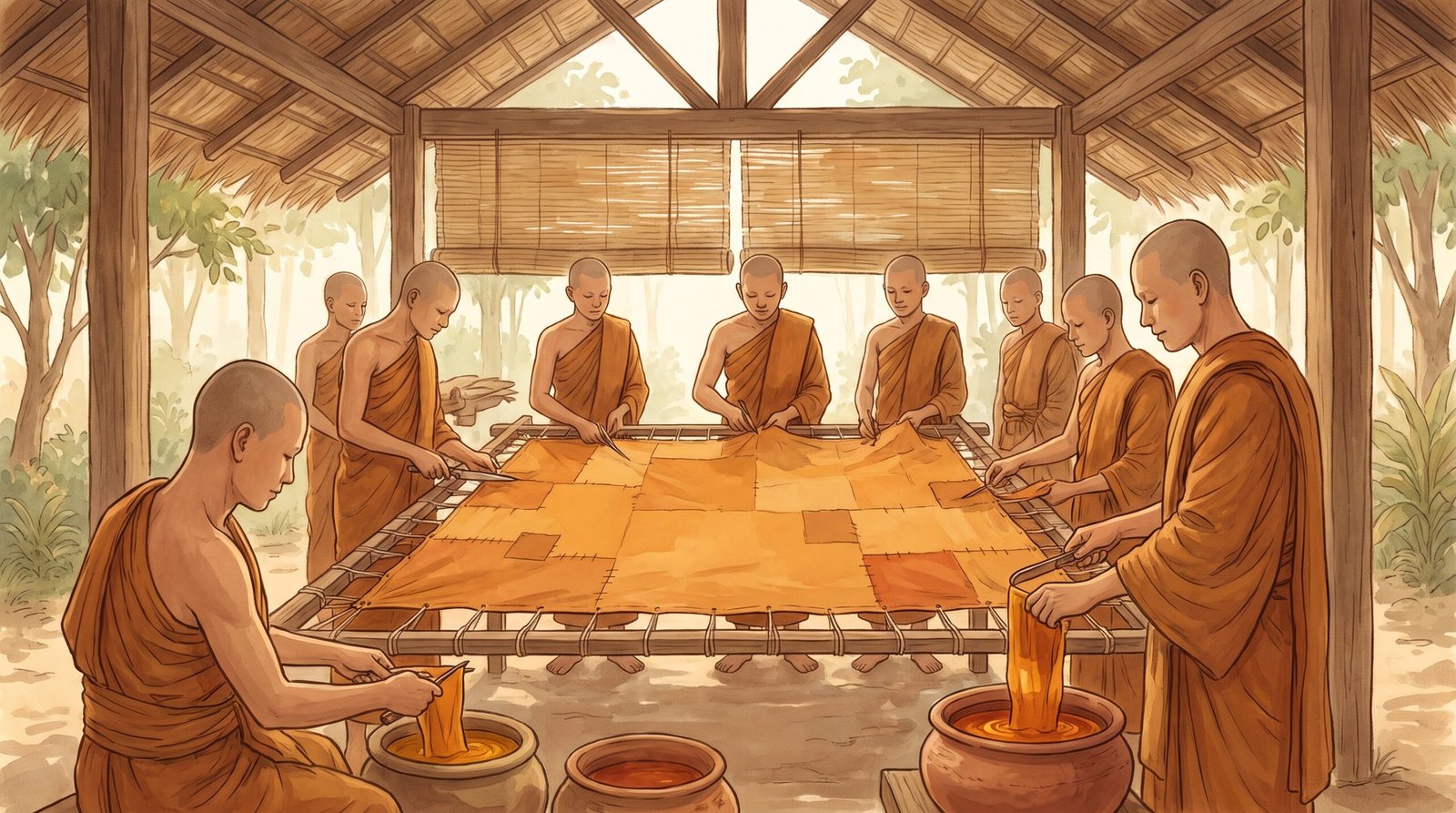
A very beautiful feature of the tradition: ideally the Kaṭhina cloth is sewn to completion on the same day. That is why many places still preserve the scene of monks cutting, sewing and dyeing the robe together on the very day of the offering — a sight that is both urgent and warm with fraternal feeling.
The five “privileges” Kaṭhina brings
When a Saṅgha properly receives the Kaṭhina robe, its bhikkhus enjoy certain relaxations of the rules (often called the five “privileges” or five ānisaṃsa) for an extended period afterwards. This is the “easing of the burden” that the Buddha established out of compassion for those who had laboured through the rainy season.
These privileges centre on relaxing certain strict rules about keeping and being apart from one’s robes and about accepting additional robe cloth, making monastic life less rigorous during the change of season. These technical details are analysed thoroughly in the Samantapāsādikā — the commentary on the Vinaya Piṭaka and in the system of the 227 bhikkhu rules, especially the rules concerning robes.
“Bhikkhus, I allow bhikkhus who have completed the rains retreat to spread the Kaṭhina.”
— The spirit of the allowance establishing the Kaṭhina ceremony in the Vinaya Piṭaka (Mahāvagga).
The spirit of the robe offering
Looked at deeply, Kaṭhina is a beautiful model of cooperation between two communities. Laypeople have the opportunity to practise generosity at its most solemn of the year; the Saṅgha practises harmony as it receives the cloth together, makes the robe and agrees on whom to give it to. Neither side is “bestowing a favour” on the other — both cultivate merit together in a very healthy rhythm of mutual dependence.
For householders today, the spirit of Kaṭhina suggests a few practical lessons. First, giving is most beautiful when it is timely and fitting — more is not necessarily better; it is the heart and the appropriateness that create value. Second, good deeds done together last longer and bring more joy — like a robe sewn by many hands. This tolerant and practical outlook is presented in a very approachable way in Vinaya-mukha — the gateway to the Vinaya Piṭaka.
Pāli glossary box
Closing words: a robe of compassion
Behind the seemingly elaborate conditions of Kaṭhina lies a simple message: a community supports one another with both thoughtfulness and loving-kindness. Those who offer the robe learn to give at the right time; those who receive it learn to accept in harmony. Once we understand this, we see that the robe-offering ceremony is not merely an ancient ritual but a very modern reminder: let our good deeds be done together, at the right time, and with all our reverence.
Frequently asked questions
How does Kaṭhina differ from an ordinary robe offering?
Robes can be offered at any time, but Kaṭhina is held only once a year, within the one-month window after the rains retreat, with strict conditions and a strict sequence of formal Saṅgha procedure.
How many Kaṭhina ceremonies can a monastery hold each year?
Only one. A dwelling that has completed the rains retreat receives only one Kaṭhina for that season — which makes the ceremony all the more rare.
Why should the robe be sewn within the day?
It is the traditional ideal, recalling the origin of the “cloth-stretching frame” and expressing harmony as the whole Saṅgha joins hands to finish the robe in time for the offering.
What do laypeople prepare for the Kaṭhina ceremony?
Most important is the robe cloth, along with supporting requisites. But the essence remains a sincere heart and proper timing according to the Dhamma, rather than lavish offerings.
What are the five “privileges” of Kaṭhina?
They are certain relaxations of the rules on keeping and accepting robes for a period after the ceremony, making monastic life less rigorous during the change of season.
Do Vietnamese Buddhists hold Kaṭhina?
Yes. In Theravāda temples in Vietnam and throughout Southeast Asia, Kaṭhina (the robe-offering ceremony) is one of the most eagerly awaited great ceremonies of the year.
Explore the Vinaya Piṭaka more deeply
Every Saṅgha ceremony is a treasury of wisdom. Start here:
A map of the whole Vinaya Piṭaka.
Where the chapters on the rains retreat and Kaṭhina are described.
The robe rules related to Kaṭhina.
Detailed commentary on the robe offering.
References & trusted tools
- SuttaCentral — Kaṭhinakkhandhaka (Mahāvagga) — the Pāli original and translation of the chapter on the Kaṭhina ceremony.
- The Buddhist Monastic Code II (Thanissaro Bhikkhu) — analysis of the rules on Kaṭhina and robes.
- Tipiṭaka.org (VRI) — the complete Chaṭṭha Saṅgāyana edition.
- Digital Pāli Dictionary — look up the terms kaṭhina and cīvara.
- Pali Text Society — the translation The Book of the Discipline.


