A Theravāda bhikkhu has no salary, no bank account, no house of his own — so what sustains his monastic life for decades on end? The answer fits into two words: the four requisites. They are the four most basic needs of a human being, pared down to the bare minimum and upheld by a beautiful bond between the one who gives and the one who receives. Understanding the four requisites, we not only understand how the Saṅgha survives, but also learn a deep lesson about having enough.
What are the four requisites — the big picture first
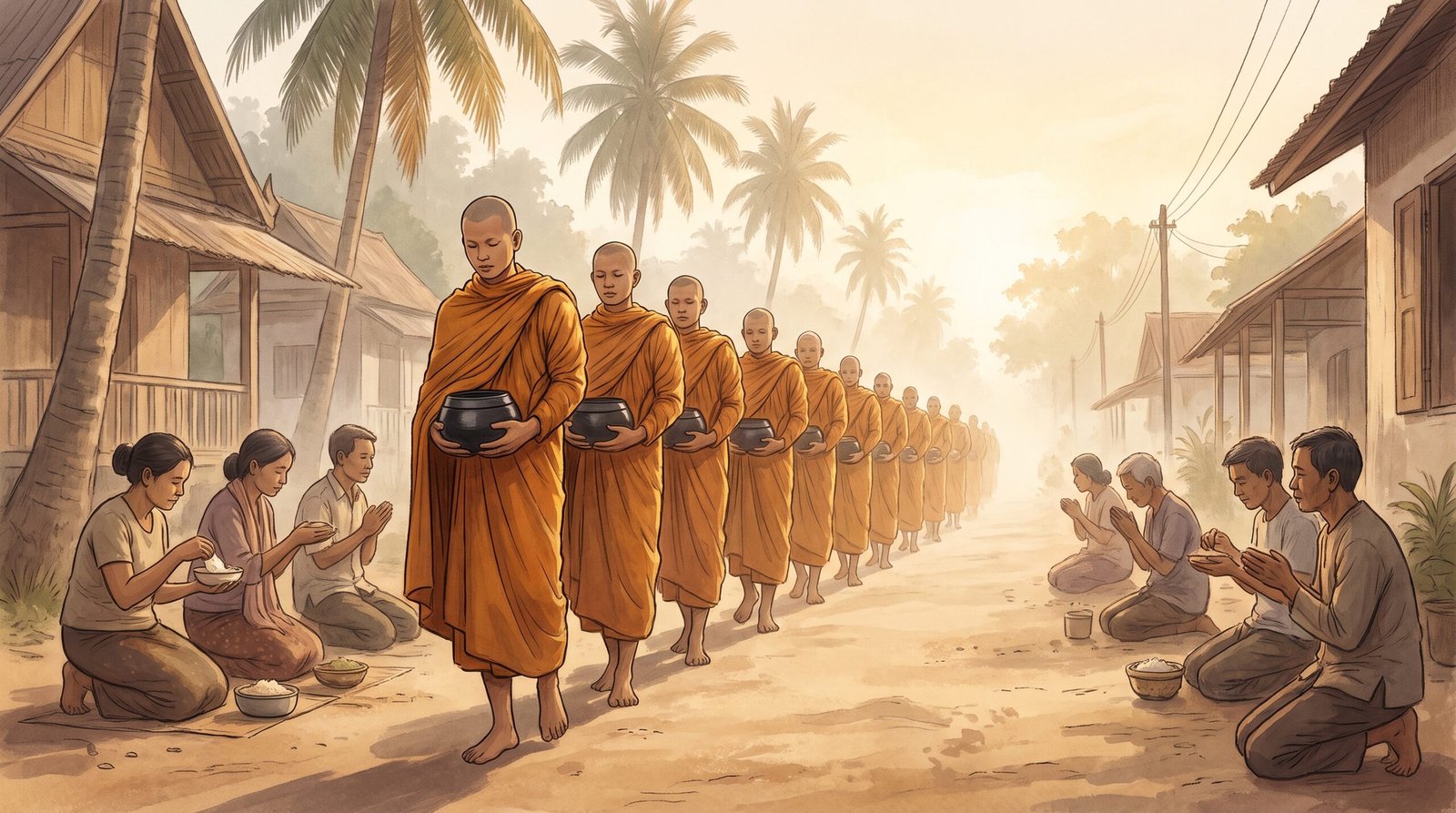
The four requisites (Pāli: catu-paccaya, “four supports”) are the four necessities that lay followers offer to sustain the monastic life. The Buddha designed the life of the Saṅgha around exactly these four things — no more — as a declaration of fewness of wishes. Monks do not accumulate wealth, do not engage in trade, and do not accept money in the ordinary sense; they rely entirely on the generosity of the community for their essential needs.
This deliberate dependence is in fact a wise design: it keeps the Saṅgha humble, close to the people, and constantly reminded that every mouthful of food and every piece of cloth comes from the sweat of others. To see where the four requisites sit within the framework of the monastic discipline, you can visit the section Vinaya Piṭaka — the Basket of Discipline.
The four items: robes, food, lodging, medicine
These four requisites cover the full range of a human being’s survival needs: clothing, eating, shelter, and healing. So compact that they can hardly be reduced any further.
Each item comes with a whole system of training rules to keep it pure: robes must be received and used properly, food must be taken at the right time and in the proper way, lodging must be just sufficient, and medicine must be allowable. These detailed rules are scattered throughout the 227 rules of the bhikkhu’s code and the chapters on requisites in the Khandhaka.
Why only four things are needed
The number “four” is no accident. It reflects a core philosophy of the path: the fewer the material ties, the lighter the mind for practice. When needs are reduced to a minimum, the practitioner is freed from the countless hours, energy and worries that ordinary people spend acquiring and guarding possessions.
Imagine someone on a long journey with a featherweight backpack holding only what is truly needed. They walk faster, go farther, and tire less than one who hauls an entire fortune along. The four requisites are exactly that “minimalist backpack” of the monastic life — just enough to live, light enough to travel far.
Reflection when using — the secret of enough
This is the most subtle and most beautiful part. Monks are taught to practise wise reflection each time they use the four requisites: before putting on the robe, eating a meal, using a dwelling or taking medicine, the monk reminds himself of the true purpose of that item. The robe is worn not for beauty, but to cover the body and maintain decorum; food is eaten not for indulgence or gratification, but to sustain the body for the practice of the path.
This reflection turns every everyday act into a moment of practice. That is also why the tradition places such emphasis on “using the requisites wisely.” The subtle psychological analysis behind this teaching is developed by the commentators in the Samantapāsādikā — the Vinaya commentary.
The giver is nourished too
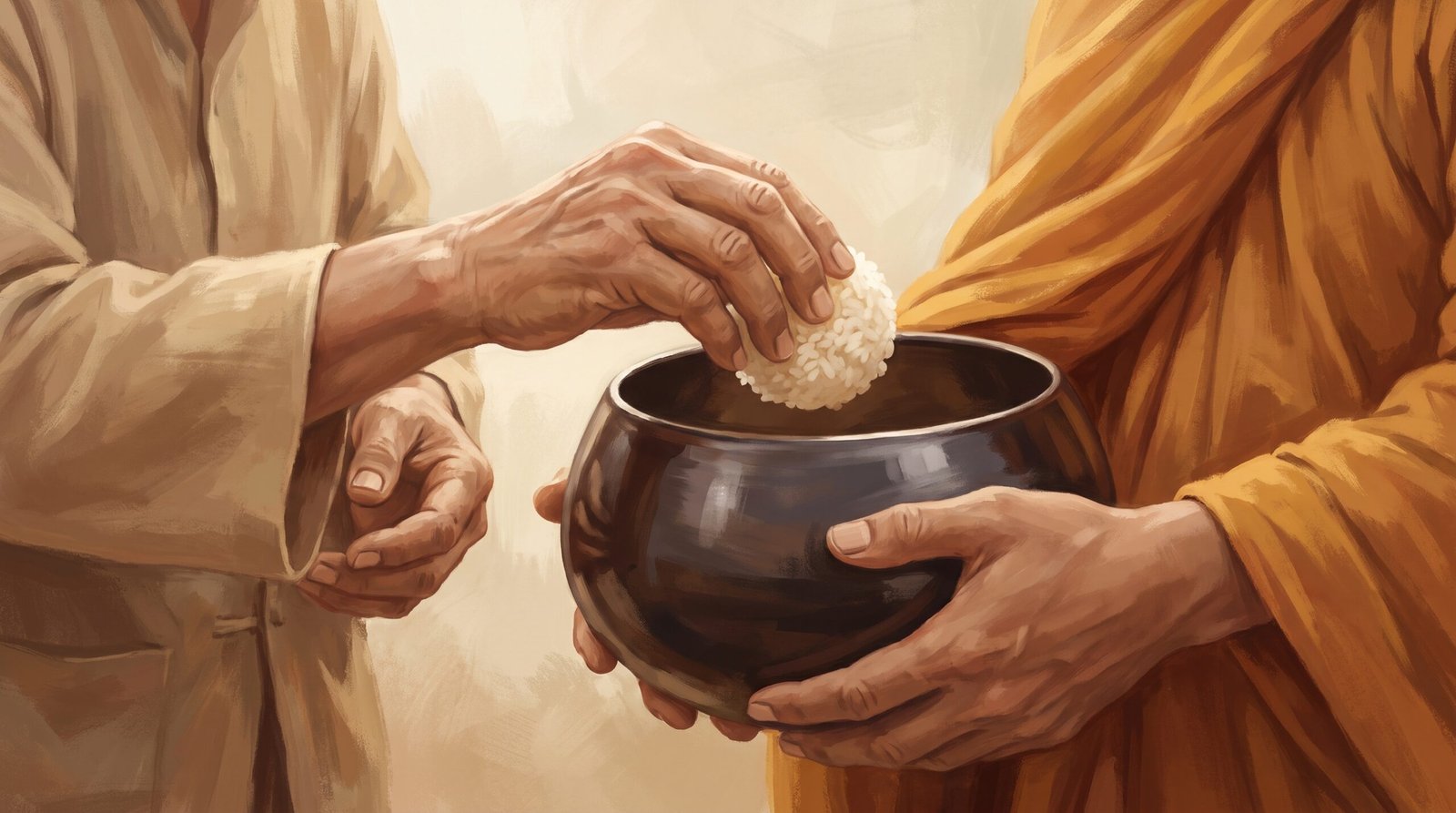
A common misunderstanding is that in the four requisites only the monks “benefit.” In fact this relationship clearly runs both ways. When lay people make offerings, they are practising generosity (dāna) — one of the foundational practices that reduces attachment, widens the heart’s kindness and cultivates merit. The Saṅgha becomes a “field of merit” in which people sow wholesome seeds; in return, the Saṅgha nourishes the community with the Dhamma and the example of a pure life.
“Reflecting wisely, one uses almsfood not for amusement, not for intoxication, not for adornment… but only for the maintenance of this body, to support the holy life.”
— The spirit of the reflection on almsfood in the Pāli Canon.
Lessons for lay people
You do not live on the four requisites, but their spirit can become a very practical companion. First, try to distinguish “needs” from “wants”: most financial stress and household clutter comes from things we “want” rather than truly “need.” Second, borrow the habit of reflecting before consuming: a small question — “what am I buying/using this for?” — can save you a great deal. Third, practise giving as a way of nourishing the mind, not merely as helping others. This wise and approachable perspective is beautifully presented in Vinaya-mukha — the gateway to the Vinaya.
Pāli glossary box
Conclusion: the art of enough
The four requisites teach us something the consumer age easily forgets: happiness is not proportional to the number of things we own. A monk with four simple requisites can live far more at ease than many people who have plenty yet still feel lacking within. Understanding the four requisites, we not only understand how the Saṅgha survives, but also receive a gentle invitation: try living a little more simply, reflecting a little more, and giving a little more widely.
Frequently asked questions
What do the four requisites include?
They comprise four items: robes (cīvara), almsfood (piṇḍapāta), lodging (senāsana) and medicine (bhesajja) — covering the full needs of clothing, food, shelter and healing.
Are Theravāda monks allowed to keep money?
According to the original monastic rules, a bhikkhu does not accept or keep money. In practice, different traditions handle this in different ways, but the spirit of fewness of wishes remains at the core.
Why do monks go on alms round?
The alms round keeps the Saṅgha humble, close to the people, and always aware that its life depends on the generosity of others — it is a practice, not a sign of deprivation.
What does reflecting when using mean?
It means reminding oneself of the true purpose of an item before using it: wearing the robe to cover the body, eating to sustain the body for practice — so that using things is not driven by craving.
Does offering the four requisites require lavish feasts?
No. What matters is a sincere heart and suitability to real needs, not extravagance. A simple meal offered with a pure mind is already very precious.
What can lay people learn from the four requisites?
To distinguish “needs” from “wants,” to reflect before consuming, and to see giving as a way of nourishing the mind — three habits that make life lighter and more meaningful.
Explore the Vinaya more deeply
Every aspect of monastic life is a lesson. Start here:
A map of the entire Basket of Discipline.
Rules on robes, food, lodging and medicine.
Regulations on requisites and communal life.
The practical spirit of the Vinaya.
References & trusted tools
- SuttaCentral — Vinaya Piṭaka — Pāli originals and translations of the chapters on robes, food and medicine.
- The Buddhist Monastic Code I (Thanissaro Bhikkhu) — an analysis of the rules concerning the four requisites.
- Tipiṭaka.org (VRI) — the complete Chaṭṭha Saṅgāyana edition.
- Digital Pāli Dictionary — look up paccaya, piṇḍapāta, dāna.
- Pali Text Society — translation of The Book of the Discipline.


